Automatic perturbation kernels for biological applications of Approximate Bayesian Computation sequential Monte Carlo with random forests
Yanjie Chen and Khanh N. Dinh
In Proceedings of the 21st Conference on Computer Science and Intelligence Systems (FedCSIS), Annals of Computer Science and Information Systems, Vol. 47, pp. 487–493 , 2026
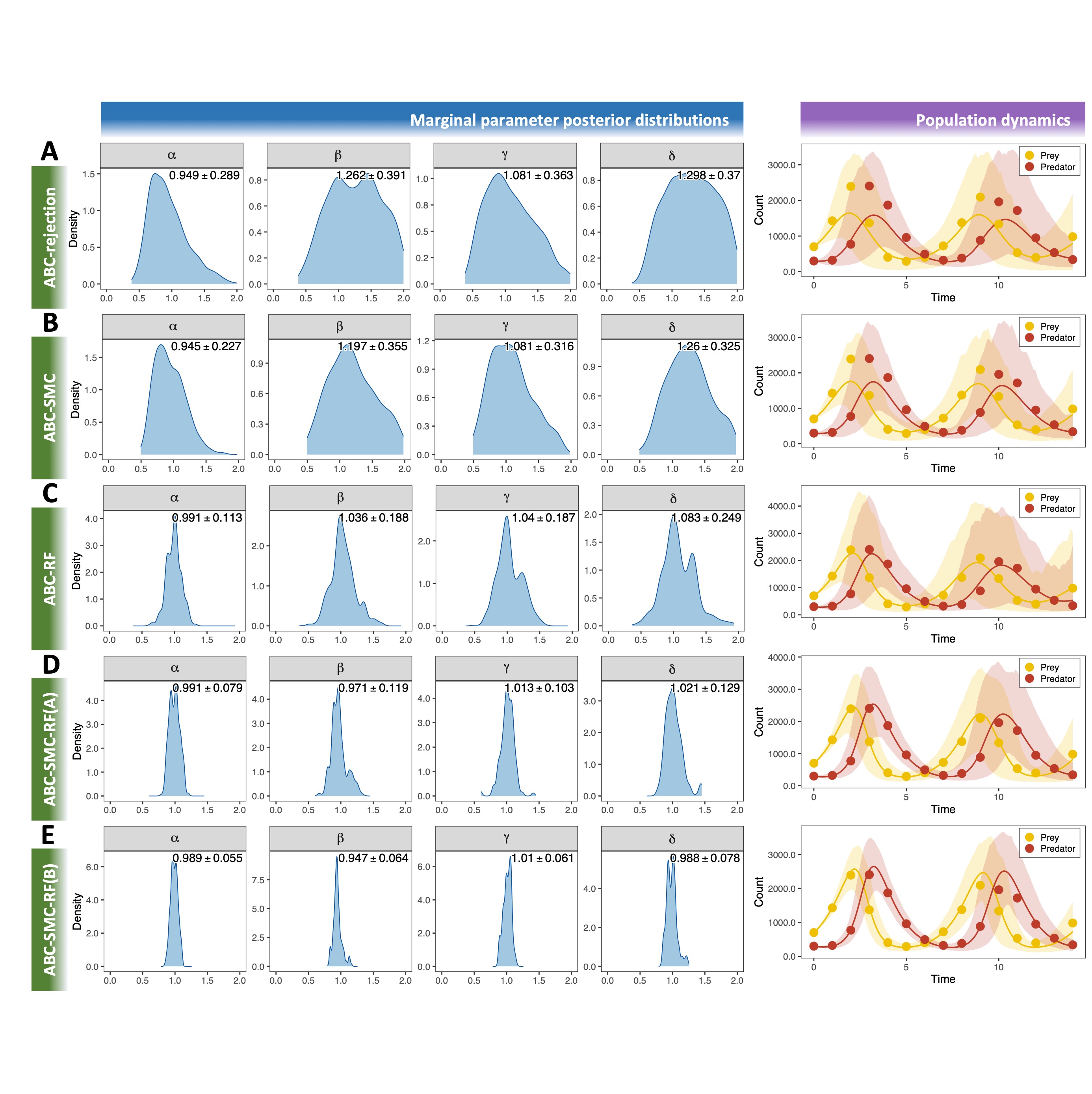
We recently introduced Approximate Bayesian Computation sequential Monte Carlo with random forests (ABC-SMC-RF), a novel likelihood-free inference method that combines the robustness of random forests and the efficiency of the Approximate Bayesian Computation sequential Monte Carlo (ABC-SMC) framework. In this work, we examine the selection of parameter perturbation kernels and their impact on ABC-SMC-RF’s results. We evaluate the performance of an automatic and adaptive perturbation scheme, previously developed for ABC-SMC. Across examples drawn from different realistic biological contexts, we show that (i) ABC-SMC-RF produces precise and accurate parameter inferences, without requiring extensive hyper-parameter tuning, and (ii) the adaptive perturbations yield optimal performance in ABC-SMC-RF, further reducing practical barriers to its adoption in many settings. We expect ABC-SMC-RF, armed with the automatic perturbation scheme, to be well positioned for supporting different scientific problems that require robust, efficient and convenient parameter estimation.
@inproceedings{chen2026perturbation,title={Automatic perturbation kernels for biological applications of Approximate Bayesian Computation sequential Monte Carlo with random forests},author={Chen, Yanjie and Dinh, Khanh N.},booktitle={Proceedings of the 21st Conference on Computer Science and Intelligence Systems (FedCSIS)},series={Annals of Computer Science and Information Systems},volume={47},pages={487--493},year={2026},publisher={PTI},doi={10.15439/2026F2839},url={https://doi.org/10.15439/2026F2839},issn={2300-5963},isbn={978-83-977088-1-5},}
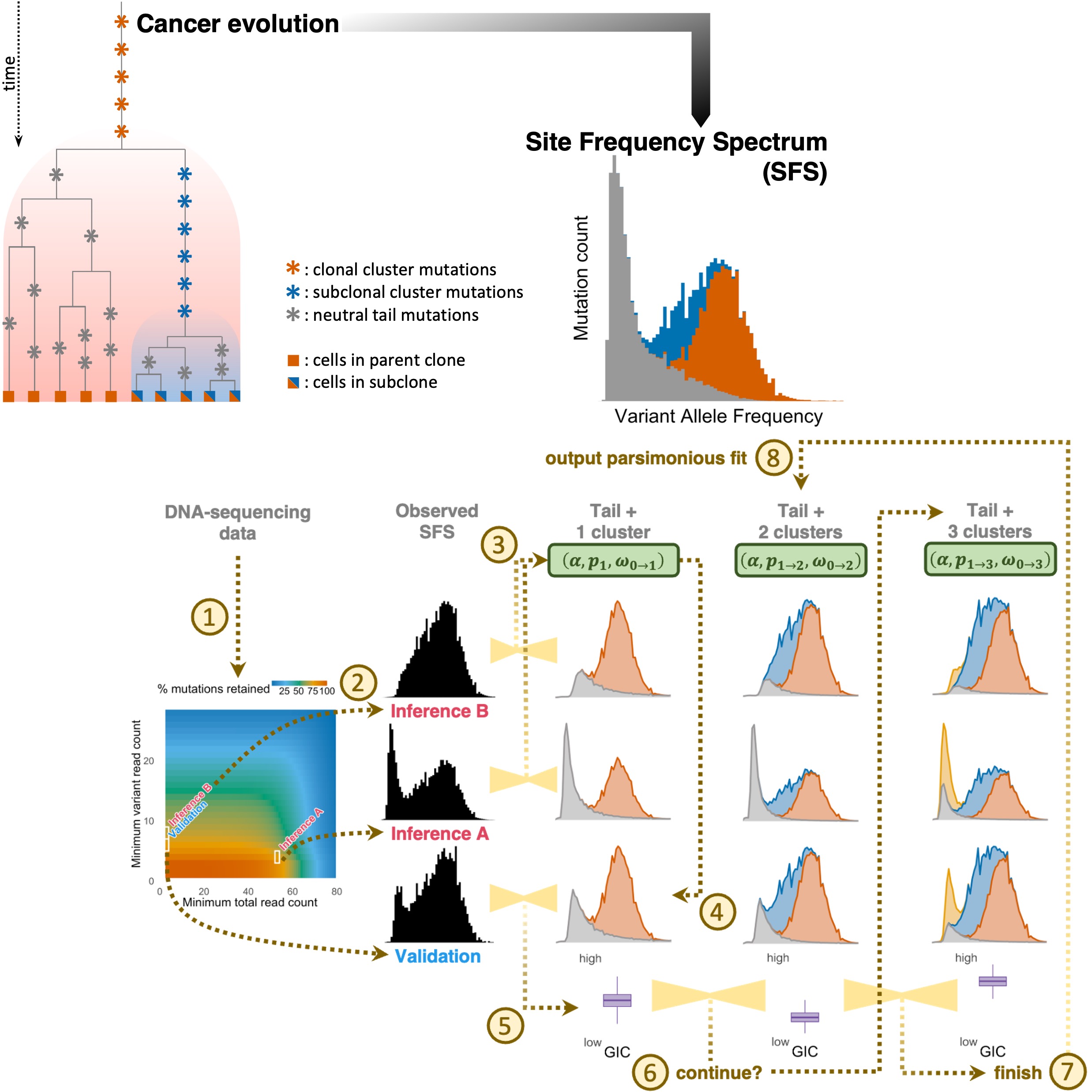
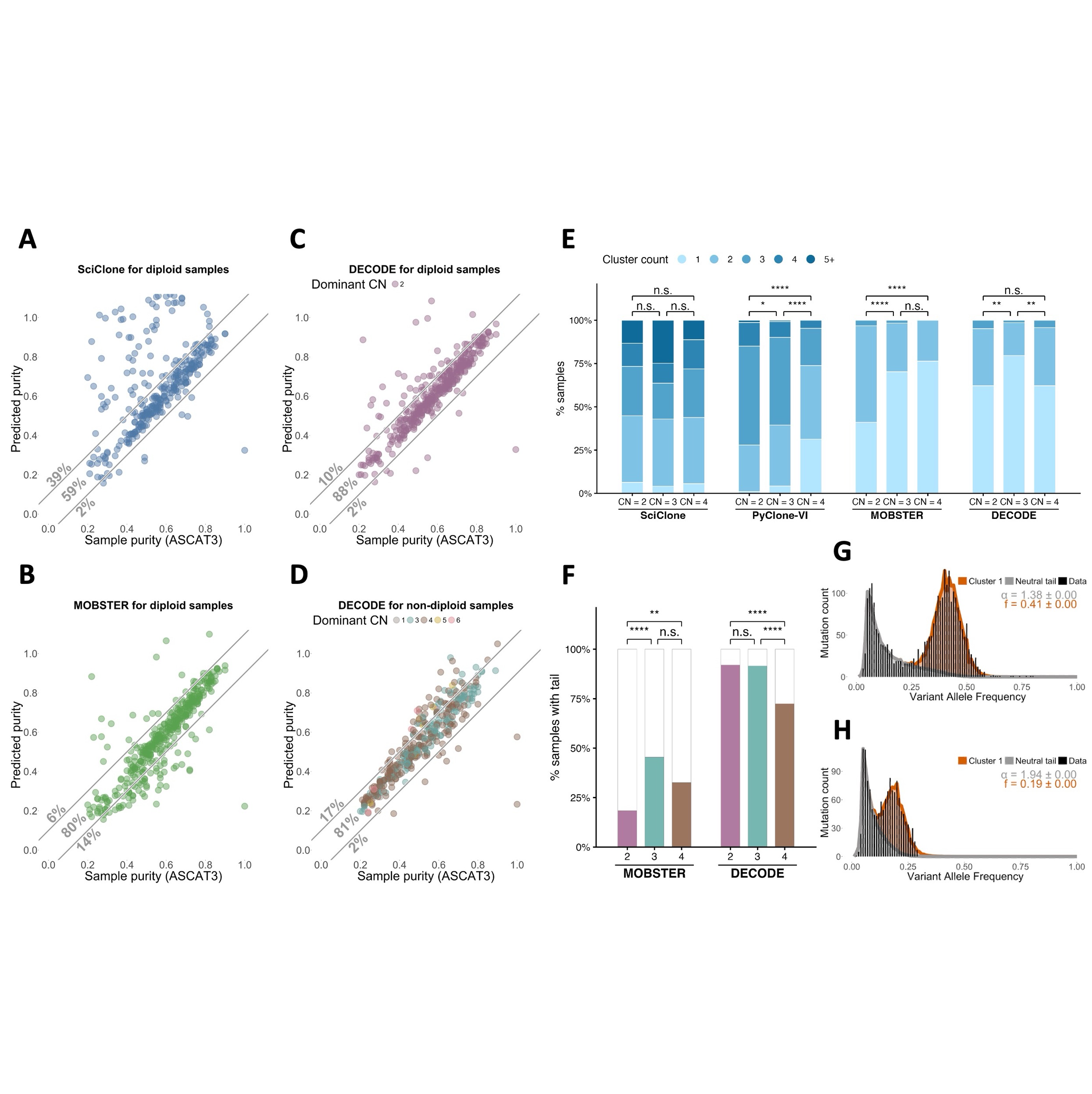
Recent evidence shows that despite considerable effort, currently available algorithms for estimating intra-tumor heterogeneity (ITH) remain limited. We developed DECODE (Deciphering Cancer Origin from DNA Evolution), a novel mutation clustering method that incorporates the impact of sample-specific sequencing coverage and mutation calling biases. On synthetic data, DECODE outperformed existing methods across multiple clonality metrics and accurately detected and characterized the neutral tail in the site frequency spectrum (SFS), which encodes the tumor’s ongoing expansion mode. In acute myeloid leukemia, accounting for the neutral tail enabled DECODE to yield more parsimonious clonal decompositions that align more closely with known subclonal dynamics that drive relapse. Applied to data from The Cancer Genome Atlas, DECODE not only detected a neutral SFS tail in most samples across tumor types but also uncovered a clinically meaningful link between ITH and survival in low-grade glioma. By jointly inferring clonality and expansion mode, DECODE provides two complementary and prognostically relevant readouts of tumor evolution from single tumor genomic samples.
@article{chen2026accurate,title={Accurate detection of tumor clonality and ongoing expansion mode from genomic data},author={Chen, Yanjie and Jaksik, Roman and Terranova, Peter and El Baghdadi, Sara and Koval, Andrew and Kurpas, Monika K. and Tavar{\'e}, Simon and Kimmel, Marek and Dinh, Khanh N.},journal={bioRxiv},year={2026},month=jun,publisher={Cold Spring Harbor Laboratory},doi={10.64898/2026.06.15.732415},url={https://pubmed.ncbi.nlm.nih.gov/42367953/},}
In preparation
Refining breast cancer stratification through improved mutation clustering of genomic samples
Yanjie Chen and Khanh N. Dinh
Submitted
Generative data augmentation methods for miRNA/RNA-seq
 Refining breast cancer stratification through improved mutation clustering of genomic samplesSubmitted
 Generative data augmentation methods for miRNA/RNA-seqPreparing manuscript